
Dancing Two Eagle Spirit, Native Canadian Elder visiting Wales

 Dancing Two Eagle Spirit, Native Canadian Elder, is coming to Peacehaven Healing Centre for 2 days on 10/11 October, 2015 in which she will share ceremonies and teachings of her Native culture.Born of an Algonquin father and Cree/French mother, Sandy Leo turned to her First Nations roots to help deal with her past and set the foundation for her future. Today Sandy Leo, a registered psychiatric nurse in British Columbia, identifies as Two-Spirited and conducts Sweat Lodge ceremonies to support the First Nations Community.
The event will be held from 10 a.m. – 4 p.m. and will cost £100 for the weekend (including refreshments) various activities will be included during both days. Please contact Lorna Coulson
lorna@beingyou.me fb Lorna Coulson 07971704445 (evenings best)
Some facts and beliefs of the First Nations Community
Our Elders tell us of people who were gifted among all beings because they carried two spirits – that of male and female
The purpose of the society is to advance Native American healing and spiritual principles for aboriginal and non-aboriginal people who self identify as two spirit persons. To educate the public on the Sweat lodge ceremony and other Native American spiritual practices.
Dancing To Eagle Spirit Society is a registered charity within the meaning of Revenue Canada “Income Tax Act section149(1)(f) and therefore qualify for tax exempt status.
We are dedicated to the healing and empowerment of aboriginal and non-aboriginal two-spirit individuals their friends and their allies. The society seeks to honour the dignity of the individual, building personal and community self esteem by providing emotional support and spiritual needs using traditional Native American ways and culture.
Below is a list of native spiritual practices available on a regular basis as well as by request.
- Two Spirit and friends Sweat Lodge ceremonies
- Regular monthly smudging circles with other organization
- Presentations/Traditional workshops upon request
- Drum making workshops, beading teachings, Native Crafts, rattle making workshop
- Annual Vision Quests/Spiritual fasts
- Our Elders frequently upon request lead or participate in Native Pipe Ceremonies for individuals and groups
- We use the Talking Circle to facilitate conflict resolution or mediate between people
- We gather the community to celebrate the changes of seasons
- Upon request, private group Sweat Lodge ceremonies
The term “Medicine Wheel” is not a native term. Initially it was used in the late 1800’s and early 1900 by Americans of European descent in reference to the Bighorn Medicine Wheel located near Sheridan, Wyoming. Later, research on the Plains identified other features characterized by a variety of stone circles and spoke configurations. Because of general similarities to the Bighorn Wheel, the term “Medicine Wheel” was extended to describe them as well.
The Big Horn Medicine Wheel consists of a central circle of piled rock surrounded by a circle of stones, “Rays” of stones travel out from the central core of rock and its surrounding circle. The whole structure looks rather like the wheel of a bicycle from the air. There is no real consensus as to when the medicine wheel began to appear in Native American Culture except to say that some of the wheels date back two to four thousand years BC, the time of the Great Egyptian Pyramids. Some archaeologist and geologist even go as far as saying that The Big Horn Medicine Wheel is as old as a few million years.
The North American First Nations regarded the circle as the main symbol for understanding life’s mysteries. They have observed that all of life was circular movement which could be seen everywhere throughout nature. Man looked out on the physical world through their eyes, which is circular. The Earth is round, and so is the Sun, Moon and planets. The rising and setting of the Sun follows a circular motion. The seasons form a circular movement. Birds build their nests in circles. Animals marked their territories in circles. In the old days, tribes lived in circular homes called tepees and their communities were arranged with the tepees in a circle. Indeed, to the Natives, the whole of life appeared to be circular.
Talking Circle or Healing Circle
An Ancient Tool for better decision making and strengthening a team or a community. It is a method of collaborative learning built on the ancient wisdom and traditions of the Natives, which uses the group process for developing direct, honest, and effective communication in a team or community, using the “circle” format. An experience of partnering in action, when the “compete and dominate” models, under the condition of increasing complexity and interdependence, are growing largely ineffective.
What the Circle Provides
A framework and tools for using the diversity of views and talents present in the group, to create better decisions and strengthen community by reaching high-level synergy. The circle format offers new possibilities for better understanding of self, others and the issues at hand. The circle improves communication and collaboration between team members and relationships with others.
How to use the Circle
As in the ancient circles of elders, each member comes to know they bring a piece of the truth to the circle – essential in itself, but only a part of the whole. The passion of our personal vision is shared without attachment, and then our position is released to the larger truth of the circle.
In the Circle, a specially chosen object, frequently a talking stick, an Eagle Feather, a Stone or a Crystal, is passed around to each person and in turn speaks his or her truth. These tools often embody the wisdom-heart of their group, and are objects of great beauty, simplicity or significance. They spiritually empower the holder of the object to speak her or his heart-felt truth as an offering to the circle. These tools should serve as an encouragement to speak from the most undefended place in one’s self.
The Rules of a Circle
Speak honestly and truthfully from the heart, be brief, and listen attentively to others, do not cross talk or interfere with what someone else is speaking.
The process is not one of making strong arguments for or against something, or convincing one another of right or wrong, but a process of becoming still and quiet, connecting with collective wisdom. When the truth is spoken on some issue it is seen and heard as such…..it rings true.
It’s listening without reacting or intending to respond, listening without being influenced by long-held images, memories or firmly held position, listening instead with a beginners mind. This is not to say that all is serious. Wholeness includes all forms of experience, good and bad, light and heavy, joyous and sad, trivial and significant. Everything is an invitation to look deeper, sense more fully.
The power of a circle lies in our seeing and feeling exactly what is, and suspending the noisy internal and external responses that get in the way. There’s no right and wrong way to do participate in a circle or to do a circle. There are only honest efforts to hear, see and say what is most real at any given moment.
The Talking Stick Circle Can Help: decision making, inquiry management, prioritizing opportunities, clarifying group dynamics, team product development, problem solving, planning, conflict resolution, creating the bonding needed to build learning communities or just about anything that organizations use meetings for.
Circle Facilitation
Whether with humor, the weaving of words or silence, strong leaders stay present and committed to what is actually taking place, rather than invested in the Circle being “successful”… a truly successful Circle is an authentic one, no matter how dark or unresolved the outcome.
Good facilitation is usually “transparent,” in the sense that members leave the Circle less impressed with the wisdom and power of the facilitator(s) than with a strong feeling of the movement and connectedness of the whole circle.
THE RITE TO SEEK A VISION
A vision quest is a rite of passage, similar to an initiation, in many Native American cultures.
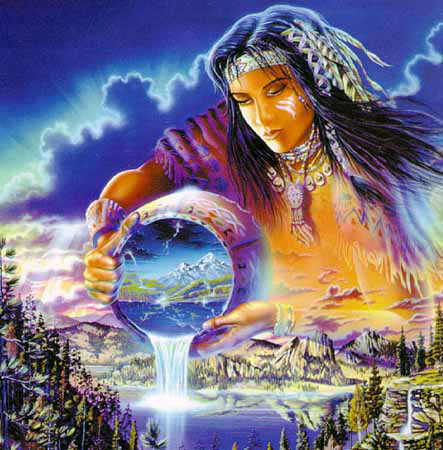
Since the beginning of the cycle of time, humanity has returned to nature to connect with spirit and to seek answers to problems of the physical realms, especially in this timeline when the messages of prophecy reveal themselves to the seeker. The quest itself is a journey alone into the wilderness seeking personal growth and spiritual guidance from the spirit and Creator. Traditionally, the seeker finds a place that they feel is special, and sits in a 10 foot circle and brings nothing in from society with the exception of water.
A normal Vision Quest usually lasts two to four days within this circle, in which time the seeker is forced to look into his or her soul.
Many times a strong urge to leave the Quest area will come to the seeker and a feeling of insanity may set in. However, the seeker normally overcomes this by reminding him or herself of the overall outcome of the Quest, causing the mind to stop wandering on random thoughts. The individual can generally find solace in the fact that he or she will not die in just two to four days.
Generally a physical representation of the vision or message such as a feather, fur or a rock is collected and placed in the seeker’s medicine bag to ensure the power of the vision will stay with the individual to remind, protect or guide him.
The Vision Quest of DTESS is for the Two Spirited People and based in Native American teachings with some variants to it. For example in most of Native America the vision quest involves some kind of sacrifice and going without food and water for four days. I believe that this is too traumatic to the body and that the vision you receive from such, is a vision based on depravation. Therefore this type of vision premise is induced by lack of water and complete loss of senses followed by a mild form of dementia due to dehydration. Can we then call it true vision? Certain First Peoples strongly felt that if you are not living your vision you are living your death.
In our practice of the Vision Quest, the Elder gathers the people seeking such and question their purpose. The Elder then makes a decision with them if the Vision Quest is going to be 1, 2, 3 or 4 days. Accordingly they are aloud to bring 1 litre of water per day and 2 pieces of bannock bread. This is so that the body does not go too much in shock especially for those who are diabetic or on different types of medications. People are then asked to bring all of their medicines but no reading material. They are to set up camp in a circle of tobacco with a doorway so that they can leave their circle when they need to do their daily business and return immediately to their circle. They are to smudge the circle at least 4 times a day and observe what is happening within themselves and their physical surrounding as the tiniest insect can bring teachings. It is a time to commune with the Universe and Spirit will tell them when they are finished.
The Purpose of the Vision Quest
The first purpose of a Vision Quest is to leave behind your everyday life and all the things you hold dearly around you to make yourself feel safe in your world today.
Second, it’s a sort of shaman’s death. You stay with your Quest long enough and seriously enough to allow your physical and spiritual centers to become open to the Universe and feel completely in communion with Great Spirit. For a few moments, time becomes irrelevant, and you are completely a part of the Universe and not just yourself.
Thirdly, a re-birth of yourself into the common life of the world you live in happens. Then it is inherent upon you to carry this illumination and knowledge, which you receive of those timeless moments, and share some of it with others and the rest you always carry for yourself.
For further details please contact Lorna Coulson